
![10 Pros and Cons of AI Flashcard Generators [UPDATE 2026]](/_next/image?url=%2Fassets%2F14.jpg&w=3840&q=75)
Top 10 Benefits of AI Flashcard Generator
1. Cut Study Prep Time by Up to 80%
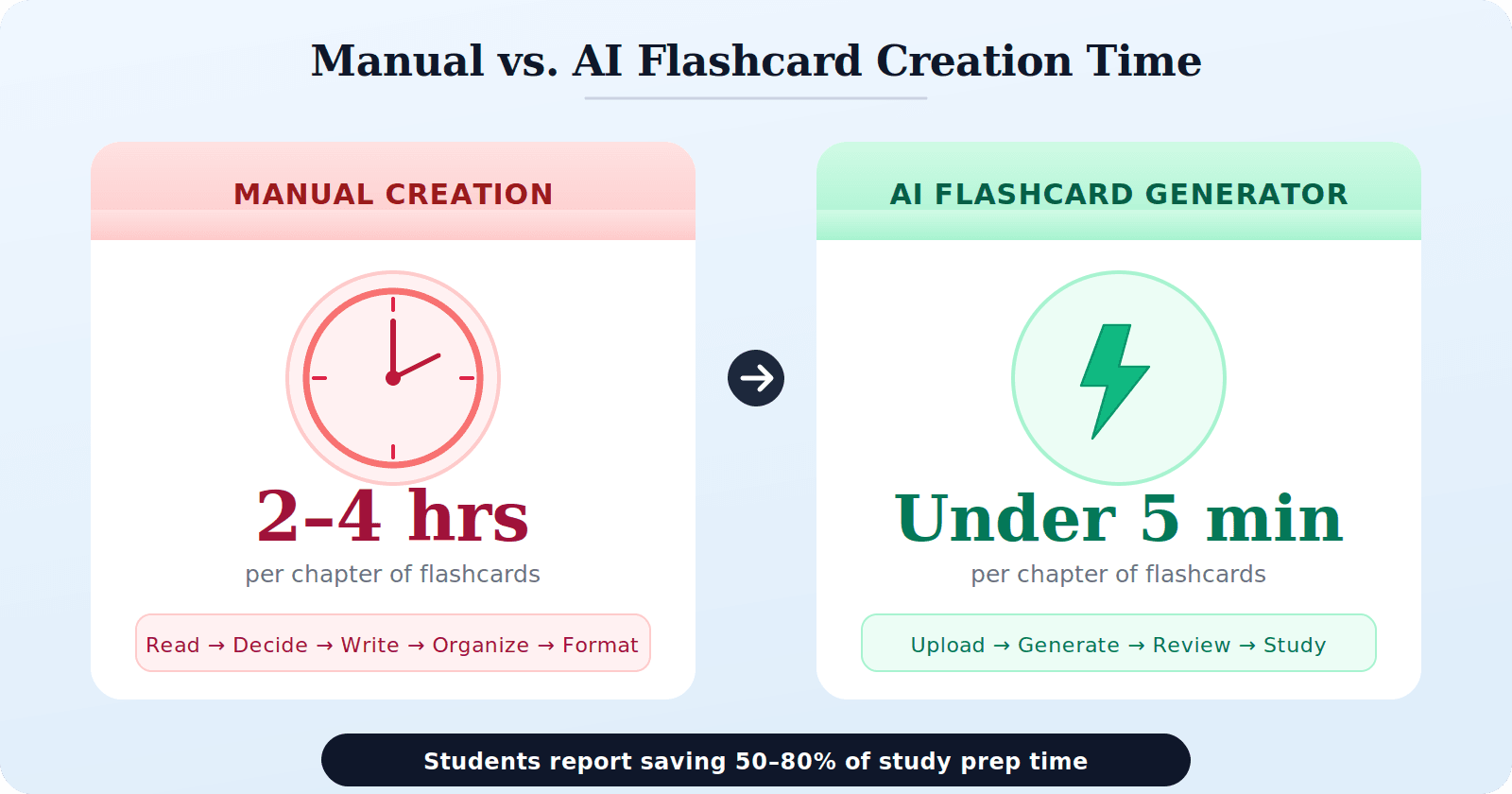
AI flashcard generators turn a 40-page PDF into a complete study deck in under five minutes. Students who adopted these ai study tools in 2024–2025 reported cutting prep time by 50–80% compared to manual methods. What used to be a time consuming process - reading, selecting key concepts, and typing each card - is now handled automatically. AceQuiz AI can process full textbook chapters, lecture recordings, video transcripts, or lengthy PDFs and output organized flashcard sets in minutes, freeing hours for actual review during high-pressure exam seasons.
Teachers benefit just as dramatically. A landmark 2025 Gallup-Walton Family Foundation national survey of 2,232 U.S. public school teachers found that educators who use AI tools at least weekly save an average of 5.9 hours per week, amounting to six full weeks of reclaimed time over a school year. By saving time on flashcard creation from lesson plans or slide decks, educators can focus on feedback, mentoring, and personalized instruction rather than spending hours on manual methods of building study materials.
2. Active Recall and Spaced Repetition That Actually Work
AI flashcard generators bake proven learning science directly into the study experience. Active recall that retrieves information from memory rather than passively rereading strengthens neural pathways far more effectively than highlighting or summarizing. Spaced repetition algorithms schedule reviews just before you're likely to forget, combating the Ebbinghaus forgetting curve and supporting long term retention. Research consistently shows these study methods improve memory retention by 20–60% versus traditional methods of studying. For a deeper dive into how to apply these techniques, see our guide on study tips for highly effective students.
Modern ai tools structure cards to enforce these principles automatically: question-based prompts, cloze deletions, and scenario-based questions push beyond simple recognition and toward deep understanding. Harder cards appear more frequently while mastered cards space out. A 2025 randomized controlled trial published in Scientific Reports found that an AI tutor built on pedagogical best practices helped students learn significantly more in less time, with effect sizes between 0.73 and 1.3 standard deviations. Students using AI powered flashcard systems consistently over a semester often see 1–2 grade band improvements in content-heavy subjects, proving that when you incorporate spaced repetition with active recall, the learning process accelerates dramatically.
3. Adapt to What You Don't Know Yet
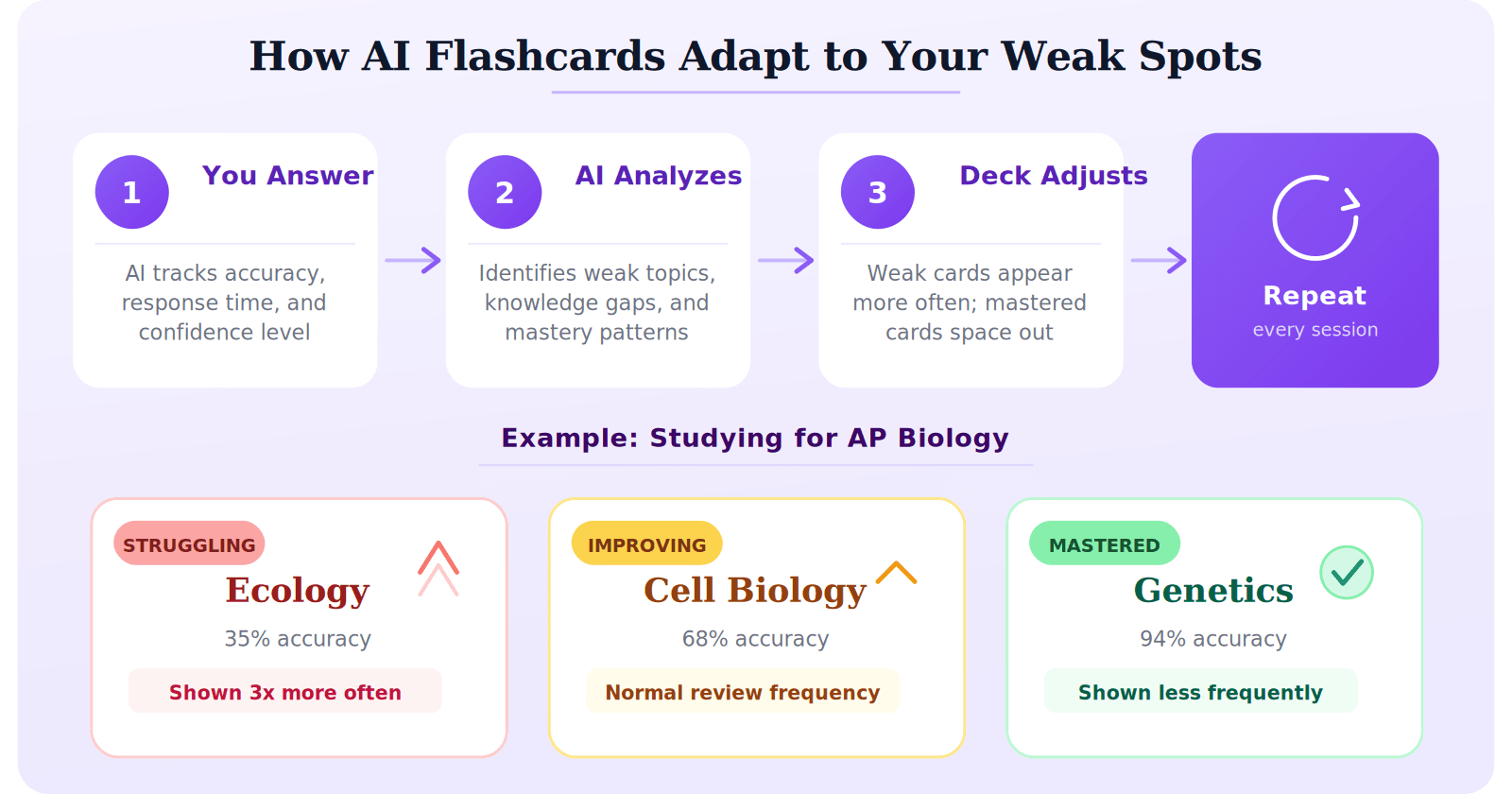
Unlike static flashcard decks where every student sees the same cards in the same order, AI powered flashcards track your accuracy, response time, and topic mastery to create a personalized learning experience. This adaptive learning approach lets every student move at their own learning pace instead of being locked into a fixed sequence. A 2024 scoping review published in Computers & Education analyzing dozens of independent studies found that adaptive learning increased academic performance in 59% of studies and boosted student engagement in 36%.
AceQuiz AI adjusts difficulty level and topic priority based on performance. Struggling with calculus integrals? The system creates targeted flashcards that prioritize those concepts. Mastering organic chemistry? Those cards appear less frequently, so you focus your study time where it matters. Personalization extends to card types too - AI mixes definitions, concept explanations, and application questions based on your learning style, deepening understanding rather than just testing recognition. This is what separates smart flashcard creation from simply generating random question-answer pairs.
4. Accept Any Study Materials
Modern AI flashcard generators accept virtually any study material: text files, PDFs, Word documents, lecture slides, whiteboard photos, screenshots, video lectures, and video transcripts. AceQuiz AI parses uploaded course materials and extracts key concepts, definitions, formulas, and relationships automatically - using natural language processing to identify the most important concepts in your source materials. If you have PDF-heavy course materials, tools like the PDF to Quiz converter can also transform documents into interactive assessments alongside digital flashcards. A 2025 structured integrative review in Frontiers in Education synthesizing 37 empirical studies confirmed that AI tools enhance customization, deliver immediate feedback, and optimize repetitive processes.
The workflow is straightforward: upload your materials, select the number and difficulty of cards, review and edit the generated deck, then start studying. You maintain full control over every card from editing, deleting, to adding additional context as needed. Teachers benefit similarly, quickly turning curricula or reading assignments into standardized flashcard sets without time consuming manual card-by-card creation. Whether you want to create AI flashcards from a single chapter or an entire semester of notes, the process takes minutes instead of hours.
5. More Engaging Study Sessions
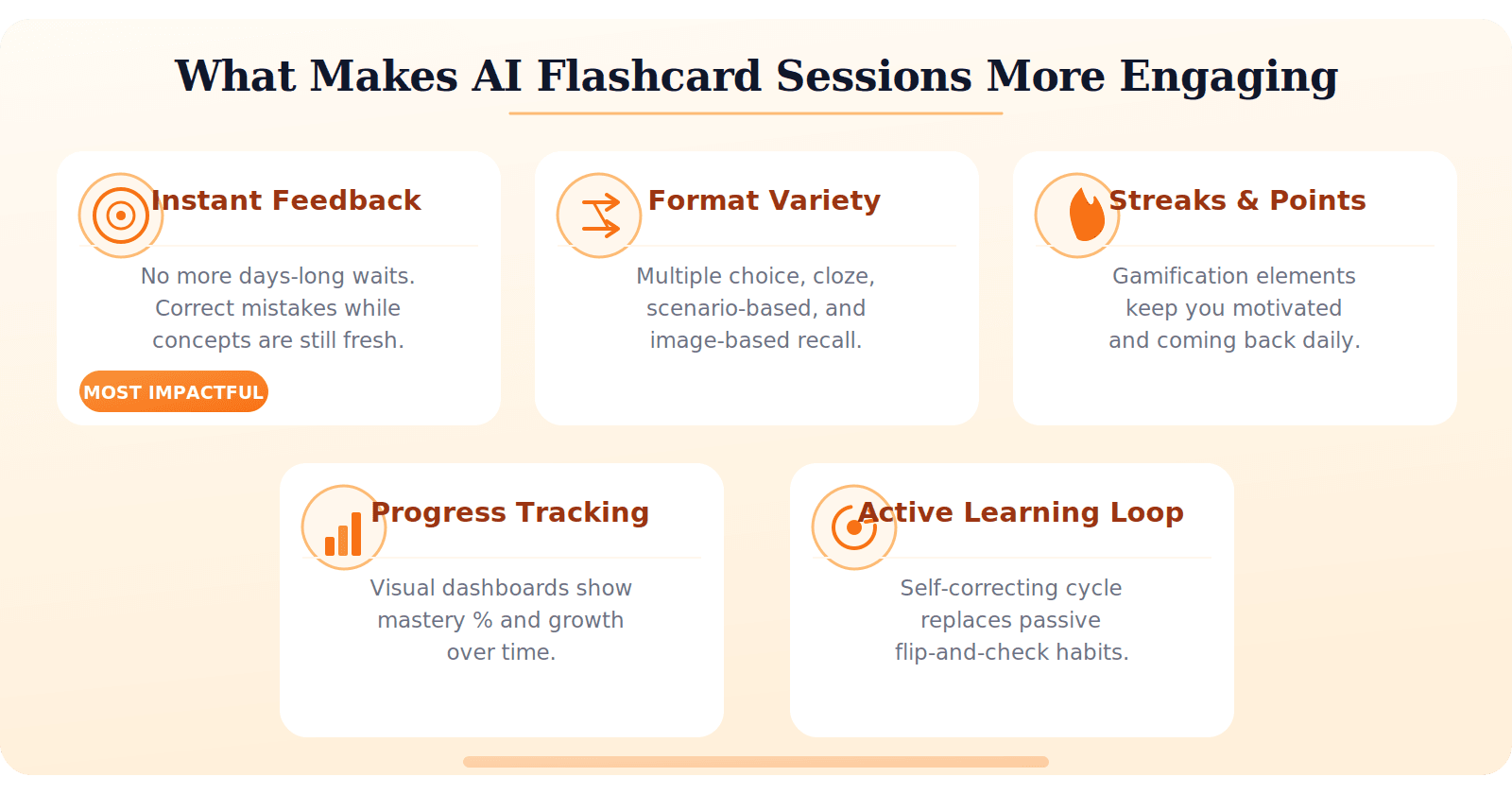
AI flashcard generators transform study sessions from a tedious process into an active, engaging study experience. Modern flashcard apps incorporate points, streaks, progress indicators, and mastery tracking to keep students motivated. A 2024 systematic review in Frontiers in Education analyzing 90 gamification interventions confirmed that gamified learning tools contribute to increased engagement, motivation, and retention of concepts.
The variety of card formats including multiple choice, cloze deletions, scenario-based questions, image-based recall, prevents habituation and forces the brain to engage from multiple angles. Unlike traditional methods where you passively flip through cards, AI flashcard generators provide immediate scoring and detailed explanations while concepts remain fresh. This transforms review from passive self-assessment into an active, self-correcting learning loop that helps students retain information more effectively across study sessions. The best study apps and flashcard apps combine this format variety with analytics to create an efficient learning cycle.
6. See Where You're Struggling
AI flashcard generators function as analytics engines, transforming performance data into actionable insights impossible to gather from paper flashcards. These ai study tools track specific details about your study sessions, which concepts you answer correctly, which ones take longer, and where patterns of mistakes emerge. A 2025 study in the Journal of Learning Analytics demonstrated that predictive models using trace and academic data could identify at-risk students early and trigger targeted interventions, confirming that analytics-driven tools meaningfully improve outcomes.
For students, analytics reveal exactly which concepts are weakest before an exam giving you full control over how to allocate your remaining study time. For educators, platforms like AceQuiz AI show which topics students struggle with across an entire class. This transforms the learning process into a data-backed experience informed by actual performance rather than gut feeling, and it's a benefit no amount of manual flashcard creation can replicate.
7. One Deck for an Entire Class
AI flashcard generators break barriers to consistent, scalable study material creation. Advanced platforms generate flashcards by the hundreds from large source documents, producing high quality flashcards aligned to specific learning objectives. The OECD Digital Education Outlook 2026 highlights how generative AI and artificial intelligence streamline education by supporting standardized assessment design, curricular alignment, and resource classification — capabilities that translate directly to scalable flashcard creation.
Flashcard sets can align to specific standards, whether IB, GCSE, AP, or university course outcomes. Many platforms and flashcard apps support multiple languages and offer accessibility features including read-aloud functions and video explanations. Sharing and cloning decks across sections ensures consistency while allowing teachers to add custom cards based on their specific lectures. Every student in the class gets the same high quality flashcards as a baseline, with the app personalizing review based on individual performance.
8. Works for Any Subject and Level
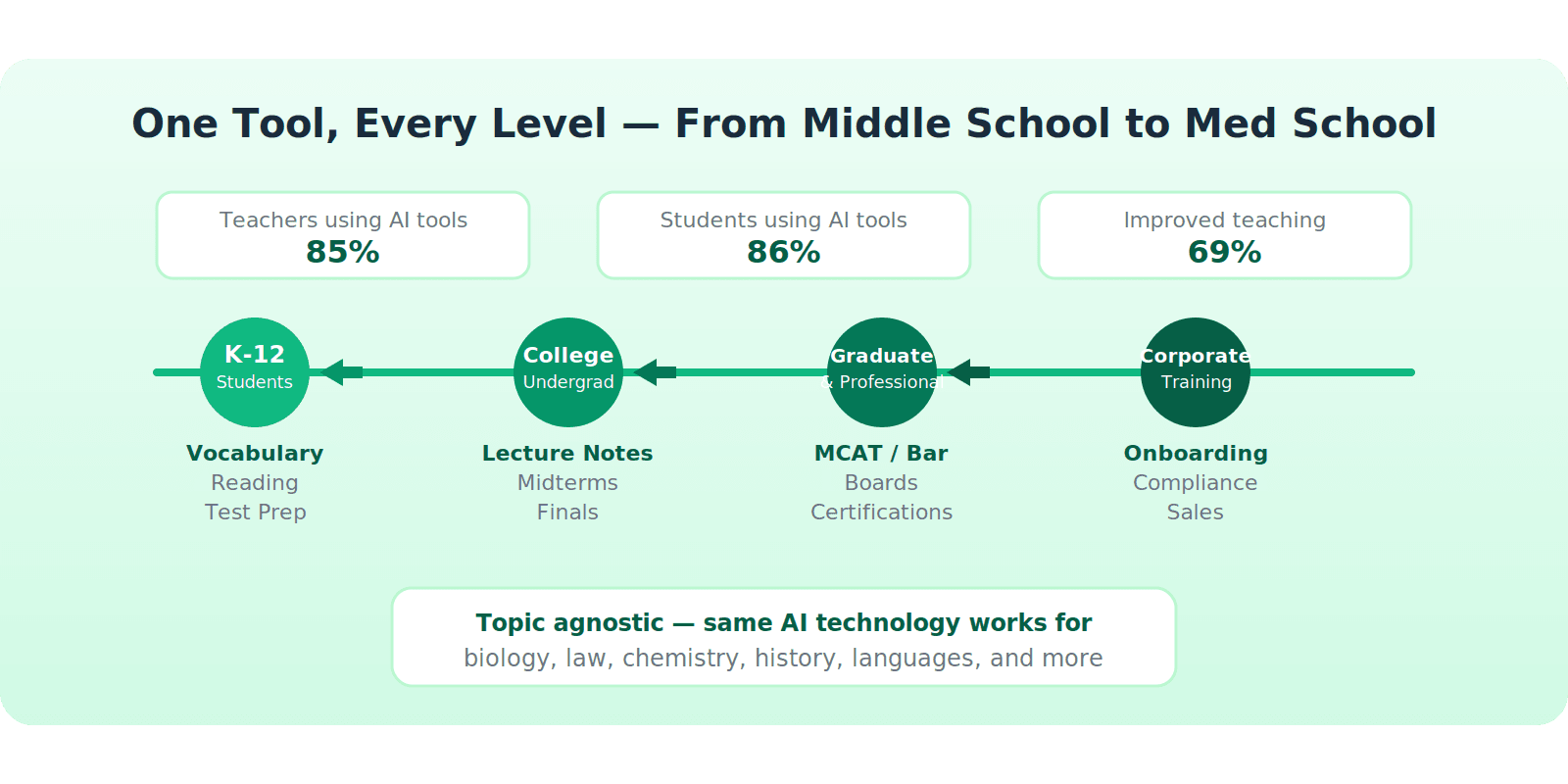
The technology is topic agnostic: whether studying elementary vocabulary, organic chemistry, medical pharmacology, or art history, these tools generate flashcards from any source material and create digital flashcards that match the subject's complexity. An October 2025 report by the Center for Democracy and Technology found that 85% of teachers and 86% of students had used AI in the preceding school year, with 69% of teachers reporting improved teaching methods.
K-12 students use AI flashcards for vocabulary building and test prep - and for language-focused subjects, a dedicated AI vocabulary quiz generator can complement flashcard decks with targeted assessments. College students transform dense lectures into digestible study materials. Medical students tackle licensing exams like the MCAT and USMLE, while law students prepare for the bar exam and board certifications. Beyond academia, corporate applications include onboarding, compliance training, and sales enablement - making AI flashcard generators and study apps a tool that serves learners throughout their careers. No single method of studying works for everyone, but the flexibility of ai generated flashcards means each student can tailor the app to their needs.
9. Frees Teachers to Teach Instead of Making Cards
By automating flashcard creation and performance tracking, ai study tools free educators to focus on professional development, lesson design, and student mentoring. Many educators use AI as a brainstorming partner - generating initial card sets, then refining them based on subject expertise and student needs. This human-AI workflow produces better study materials than either could create alone, and it means saving time without sacrificing quality.
Schools with formal AI policies see greater benefits: the same Gallup-Walton survey found a 26% larger time-saving benefit in schools with clear AI usage guidelines compared to those without, suggesting institutional support amplifies individual tool adoption. When teachers have full control over how AI tools are used in their classrooms, the benefits of ai flashcard generator technology extend across the entire learning experience.
10. Proven Quality Study Tools
AI flashcard generators make science-backed learning resources available regardless of economic background. Many platforms offer robust free versions allowing any student with internet access to create flashcards and build personalized decks. A February 2026 Coursera survey of more than 4,200 students and educators found that four in five students reported AI improved their academic performance, and 63% use AI for less than half their tasks — suggesting these study tools work as supplements, not crutches.
As explored in recent analyses of AI in education statistics for 2026, adoption has moved from experimental pilots to mainstream use faster than almost any technology in history. The democratization effect is especially significant because active recall and spaced repetition are now available to everyone through AI flashcard generators. Students who previously relied on time consuming manual methods now have access to the same efficient learning tools as their peers, leveling the playing field for personalized learning at every level.
Top 10 AI Flashcard Generator Disadvantages
1. AI Can Give You Wrong Answers
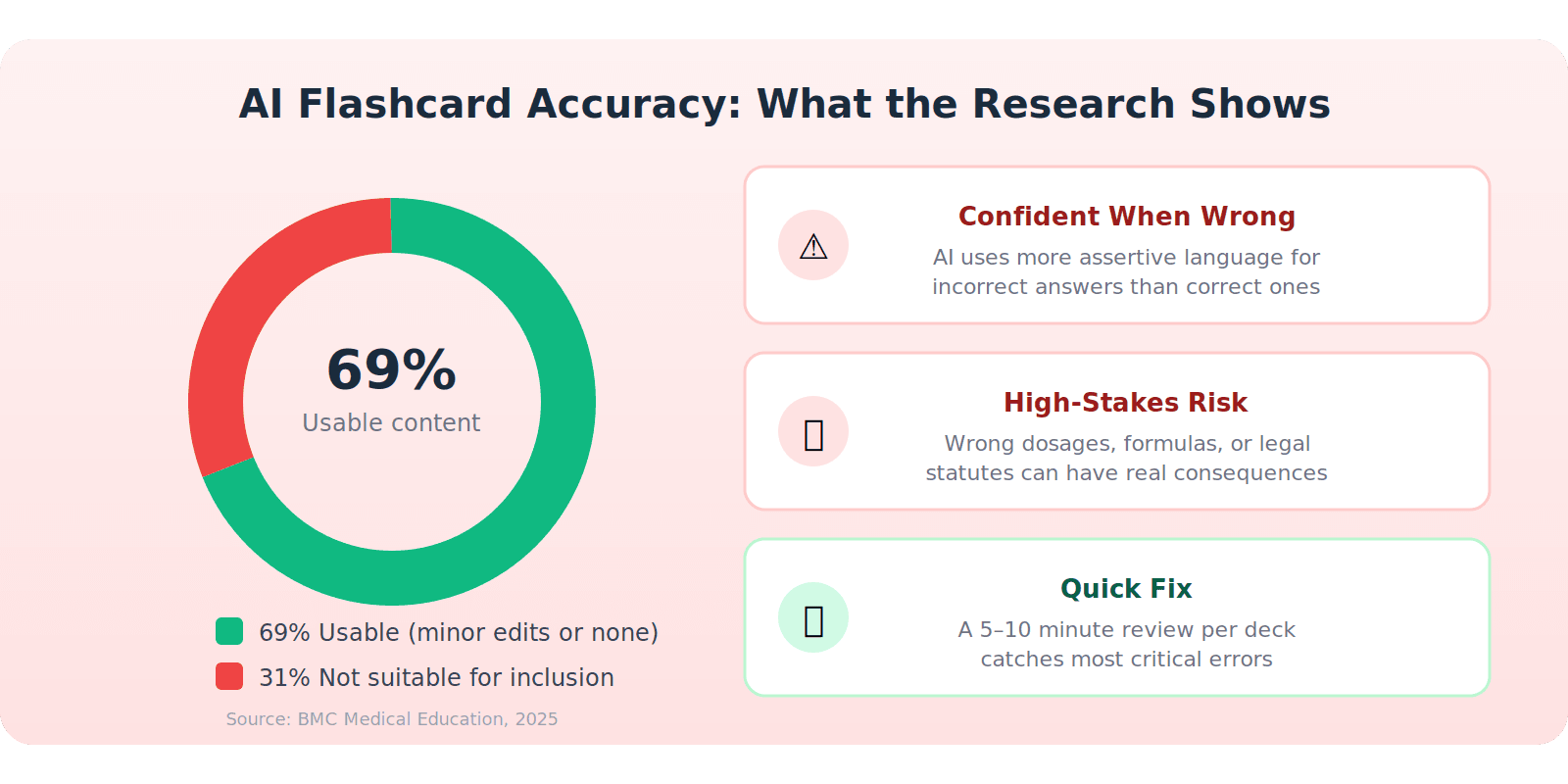
When AI flashcard generators get something wrong, they state it with total confidence. This "hallucination" tendency leads to errors like misattributed quotes, incorrect formulas, or wrong definitions, particularly in specialized subjects where natural language processing struggles with domain-specific terminology. A 2025 peer-reviewed study in BMC Medical Education found that while 69% of AI generated assessment content was usable, 31% was not suitable for inclusion.
Worse, AI models tend to use more confident language when generating incorrect information than accurate content, making errors nearly impossible to spot without subject expertise. For high-stakes subjects like pharmacology, law, or engineering, this accuracy gap is serious — medical students in particular cannot afford to study from cards with wrong answers. A quick 5–10 minute review per deck is recommended before trusting the material. Always verify specific details like dosages, dates, and formulas against your original source materials and course materials.
2. Most AI Cards Only Test Surface-Level Recall
AI systems tend to generate flashcards as predictable, surface-level question-answer pairs that test recall of definitions without pushing toward deep understanding. A 2025 cohort study in BMC Medical Education found that while AI can efficiently produce material with comparable basic properties, it lacks the depth needed for complex assessments targeting higher-order cognitive skills. Most ai generated flashcards focus on isolated facts rather than the connections between concepts.
AI spreads cards evenly across source material without recognizing the most important concepts. A human educator knows which knowledge areas matter most and creates cards approaching them from different angles to build deep understanding. AI-generated decks often need human curation — rewriting superficial cards into probing questions that answer questions about relationships between ideas and adding cards that connect concepts across topics. Relying solely on what AI generates without editing leads to shallow study sessions.
3. Your Uploaded Notes May Not Stay Private
When you upload study notes to an AI flashcard generator, where does that data go? The FTC finalized major COPPA amendments, shifting to opt-in consent for children's data. These new rules became effective June 23, 2025, with full compliance required by April 22, 2026. A critical risk is that consumer AI platforms and flashcard apps typically train on user inputs, meaning uploaded notes could enter a training dataset and once there, "unlearning" is extraordinarily difficult. Students and educators need to understand that they may not have full control over what happens to their data.
As of January 2026, 19 states have comprehensive consumer privacy laws in enforcement. According to a 2025 NEA federal regulatory overview, education institutions must now interpret data protection laws specifically for AI contexts. Confirm platforms don't use uploaded content for model training and ensure compliance with applicable state-level AI privacy guidance. Before choosing any app or platform to create flashcards, review the privacy policy to understand how your study materials are stored and used.
4. Too Much Automation Can Make Student a Lazy Learner
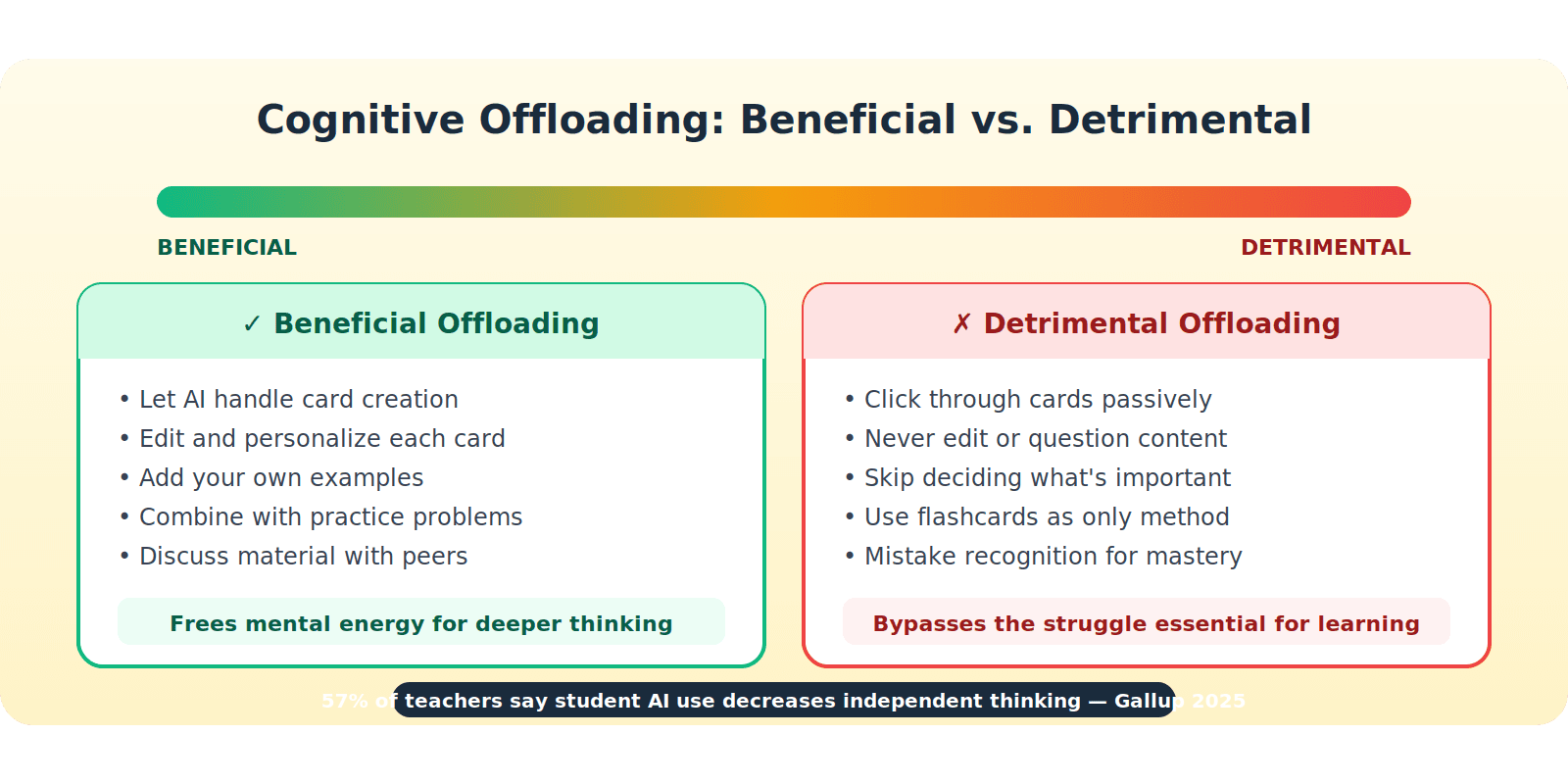
The irony: the easier AI flashcard generators make studying, the less you might actually learn. When flashcard creation is effortless, students skip the cognitive work of deciding what's important — work that itself reinforces long term memory and the learning process. A landmark 2025 study published in Societies surveying 666 participants found a significant negative correlation between frequent AI tool usage and critical thinking abilities, with younger participants exhibiting higher dependence.
According to the Gallup-Walton Family Foundation survey, 57% of teachers said student AI use would decrease independent thinking. For a broader look at this tension, see our analysis of the pros and cons of AI in education. The solution is teaching students to use AI flashcards as thinking partners: editing cards, adding personal examples, and combining them with practice problems and discussions. Relying solely on ai generated content without actively engaging in the learning process undermines long term retention and memory retention.
5. Hidden Bias in AI-Generated Content
AI flashcard generators inherit and amplify biases from their training data. A 2025 review in the World Journal of Advanced Research and Reviews found that automated systems show biases related to gender, race, and socioeconomic status, operating through multiple channels from data collection to implementation. These biases can shape the learning experience in ways students may never notice.
Bias appears subtly: historical cards centering Western perspectives, science cards using culturally specific examples, or language cards privileging certain dialects. A 2026 study in Frontiers in Computer Science found that bias can be reinforced through user interaction patterns, compounding inequities over times flashcards are reviewed. Educators should review decks for cultural assumptions and supplement with diverse materials that provide additional context beyond what ai tools generate on their own.
6. Flashcard Mastery ≠ Real Understanding
Knowing the definition of mitosis is not the same as understanding how cell division relates to tissue growth or cancer. Digital flashcards encourage isolated fact learning without requiring students to connect or apply knowledge across topics. When AI makes it trivially easy to generate flashcards by the hundreds, students may default to surface-level memorization rather than building the deep understanding needed to retain information in long term memory.
A 2026 article in Advances in Physiology Education argues that flashcards create an "illusion of mastery" or rapid recognition feels productive but masks shallow learning that fails to transfer. AI flashcards should be one component of a broader strategy that includes practice problems, written explanations, video review, and group discussion. No single method of studying, not even the best flashcard app, can replace the hard cognitive work of truly understanding a subject. Effective study methods always combine multiple approaches.
7. Not Every Student Has Equal Access
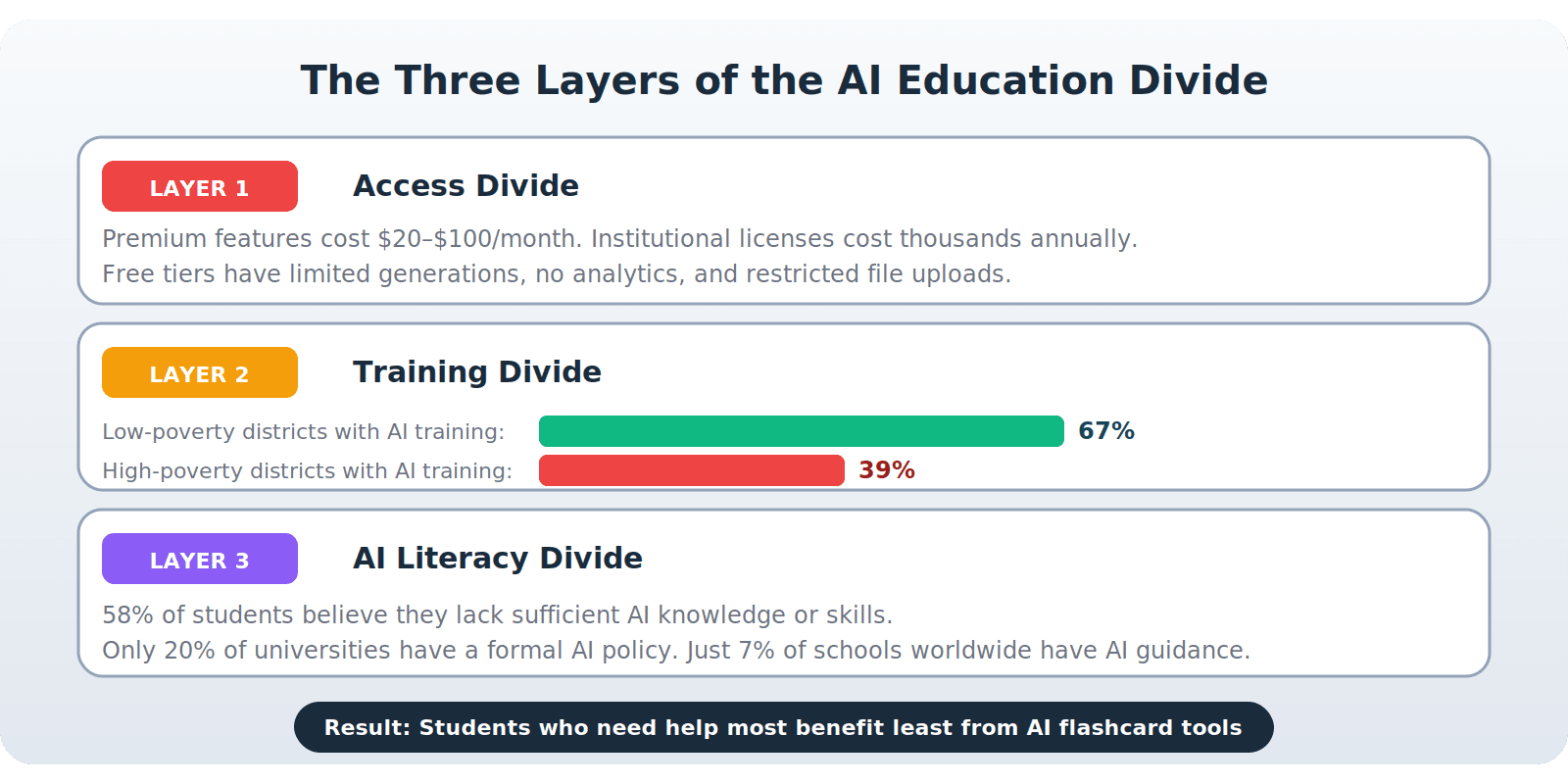
The digital divide extends beyond subscription costs for study apps and flashcard generators. A 2025 study in Digital Society found that new divides emerge because not all users possess competencies to benefit equally, success requires AI literacy and critical thinking, creating gaps between income groups and disciplines alike. Personalized learning through AI powered tools is only effective when students have both the access and the training to use them.
The training gap is arguably more damaging than cost: 67% of low-poverty districts have trained teachers on AI use versus just 39% of high-poverty districts. Only 20% of universities have a formal AI policy, and 58% of students believe they lack sufficient AI skills. AI flashcard generators risk widening achievement gaps through unequal access, training, and cultural representation - meaning the very students who could benefit most from efficient learning tools are the least likely to have them.
8. Less Face Time with Teachers and Classmates
Overreliance on AI flashcard systems risks creating isolated study sessions that undermine essential human connections. A 2025 mini-review in Frontiers in Psychology found that over-reliance on AI may diminish interpersonal skills and emotional intelligence, leading to social isolation and anxiety. When students spend all their study time alone with an app, they miss the collaborative elements that strengthen learning.
AI cannot provide encouragement, empathy, or mentorship. Study groups provide motivation, accountability, and the benefit of explaining concepts to others. The best approach uses AI tools for routine tasks while preserving human elements: study groups using AI flashcards together, teachers reviewing analytics then having face-to-face conversations, and peer tutoring building on AI-identified gaps. Relying solely on digital flashcards without human interaction limits the overall study experience.
9. Teachers May Lose Assessment Design Skills Over Time
When teachers consistently outsource flashcard creation to AI, they may lose opportunities to develop critical competencies. Crafting thoughtful study questions requires deep subject knowledge and pedagogical expertise. Research from comprehensive AI in education reviews suggests deskilling risk is most acute for novice teachers who accept ai generated content without critical evaluation. Relying solely on ai tools to create study materials can erode the skills needed to design effective assessments.
The healthiest approach treats AI as a starting point: generate initial decks, then apply expertise to refine and enhance the material. Review each card for accuracy, add examples drawn from classroom discussions or video content, and rewrite questions that only test surface-level recall. This preserves skill development while gaining efficiency benefits and ensures that flashcard creation remains a thoughtful pedagogical process.
10. Schools Struggle to Set These Tools Up Properly
Many institutions struggle with technical issues like system crashes, LMS export problems, and unintuitive interfaces in flashcard apps and study tools. The bigger challenge: only 30% of teachers receive meaningful AI tool training. According to recent research on AI literacy in education, successful implementation depends on comprehensive educator training and curriculum adaptation for modern ai tools.
Without training, AI flashcard generators become underutilized - teachers skip analytics, students use cards passively, and the personalized learning potential goes unrealized. The gap is widest at under-resourced schools that lack both infrastructure and professional development budgets, creating yet another dimension of educational inequality. Effective implementation requires not just access to ai study tools but also ongoing support to help educators and students integrate them into a productive learning experience.