

Overview
The way we test knowledge is undergoing a fundamental shift. For decades, the traditional quiz is a fixed set of questions printed on paper or loaded into a simple digital form that has been the backbone of education, corporate training, and professional certification. It is familiar, well-understood, and broadly accepted. Yet according to a MindStudio report, over 90% of university students now use AI tools for learning, while most courses still rely on traditional assessments designed in the early 2000s.
AI-powered quizzes represent a newer paradigm. These platforms use natural language processing (NLP) and machine learning algorithms to generate questions automatically from source material, adapt difficulty based on a learner's real-time responses, and deliver granular analytics that go far beyond a simple percentage score. The shift is happening fast: the global AI in education market was valued at $5.88 billion in 2024 and is projected to reach $32.27 billion by 2030, with assessment tools driving a significant share of that growth. For a full picture of how this adoption is playing out in classrooms, see our breakdown of 30+ AI in Education Statistics for 2026.
Both formats have meaningful advantages. Traditional quizzes offer consistency, simplicity, and a level of human oversight that many institutions still require. ai-generated quizzes offer speed, personalization, and data richness that are difficult to replicate manually. Understanding where each method excels and where it falls short is essential for anyone responsible for designing assessments today.
Key Differences at a Glance
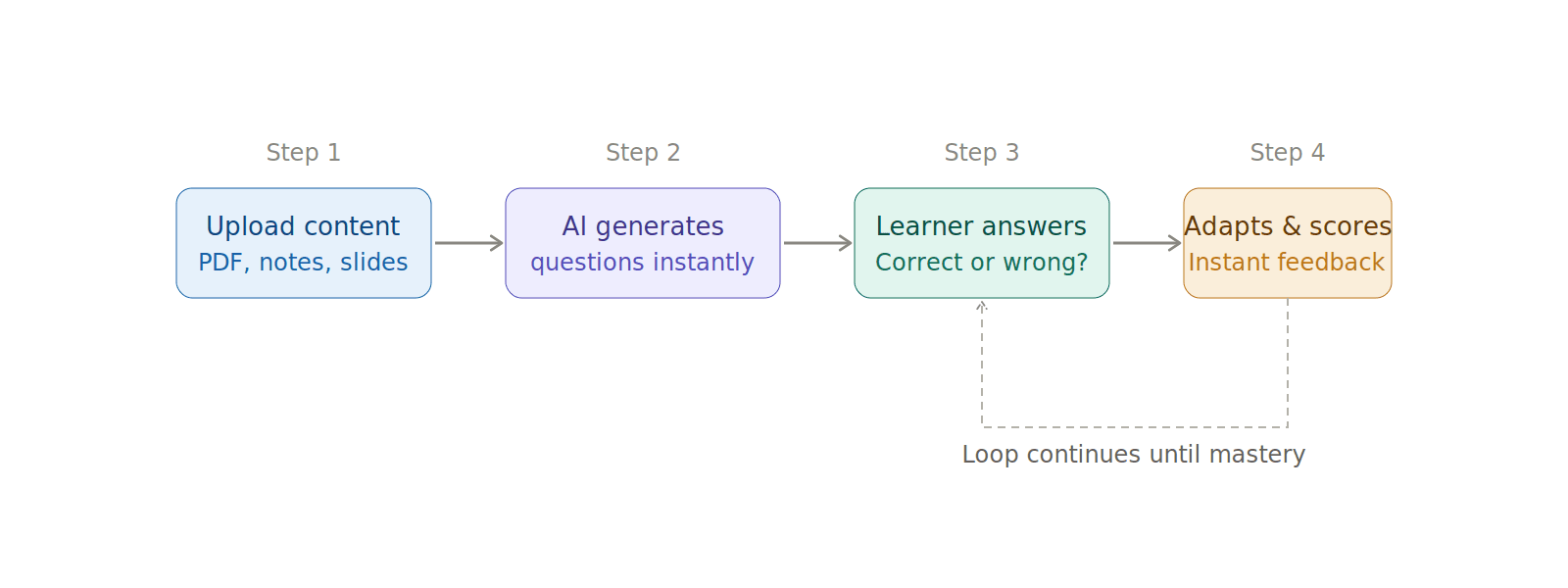
Before diving into a detailed analysis, here are the most important distinctions between AI-generated quizzes and traditional quizzes. AI quizzes auto-generate questions from uploaded content using NLP and adjust difficulty dynamically based on each learner's responses. They provide instant automated grading across all question types, including essays, along with detailed feedback and class-wide analytics dashboards. They sync across devices, support multimedia, and operate on subscription-based pricing.
Traditional quizzes are manually authored by instructors or test designers, present the same questions to every test-taker, and rely on manual or semi-automated grading. They cost little to nothing to produce, work in offline and low-tech environments, and offer the standardized, auditable conditions required by high-stakes testing contexts.
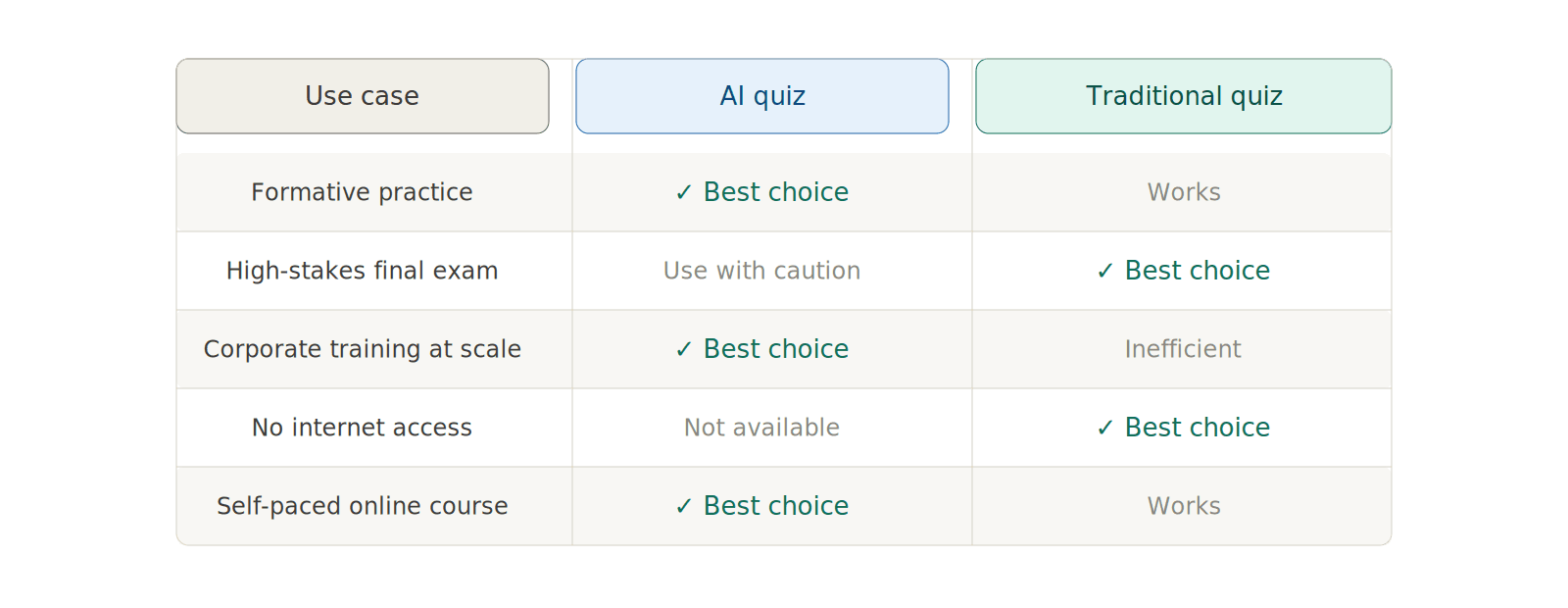
AI quizzes are generally best for formative assessment, self-paced learning, and corporate training at scale. Traditional quizzes excel at high-stakes summative exams, standardized testing, and regulatory compliance scenarios.
1) Question Quality and Generation
AI Quizzes
One of the starkest differences between AI and traditional quizzes lies in how questions are created. In a traditional workflow, an instructor or subject-matter expert writes every question from scratch, crafting stems, designing distractors for multiple-choice items, and building rubrics for open-ended prompts. This process is time-consuming but yields questions carefully aligned with specific learning objectives and vetted for clarity.
AI quiz platforms accelerate this step dramatically. By feeding source material, a textbook chapter, a training manual, a set of lecture notes, into the system, the AI can generate dozens of well-formed questions in seconds. You can also convert an existing document directly into a quiz using a tool like our PDF to Quiz generator, which extracts questions straight from uploaded files with no manual copying required. As a 2026 guide on AI quiz creation notes, today's AI assessment tools incorporate learning science frameworks like Bloom's Taxonomy directly into their algorithms, ensuring questions progress from basic recall to complex analysis.
AI-generated questions are also editable, meaning instructors can refine language, add context, or merge related concepts before publishing. Some platforms support collaborative question bank creation, so teams can pool effort and produce comprehensive assessments far faster than any individual could alone.
Traditional Quizzes
The manual process of creating traditional quizzes is often cited as a disadvantage, but it produces a level of precision and pedagogical nuance that AI cannot yet reliably match. Expert item writers tailor each question to specific course discussions, student backgrounds, and instructional contexts-details that AI, which draws from uploaded documents rather than lived classroom experience, cannot access.
A 2026 review of the top quiz software found that instructional designers get the best results when they combine AI-generated drafts with manual refinement - using the machine for first-pass creation and human expertise for final polish. For conceptually demanding material where deep understanding matters more than rote recall, this approach balances efficiency with quality.
2) Personalization and Adaptivity
AI Quizzes
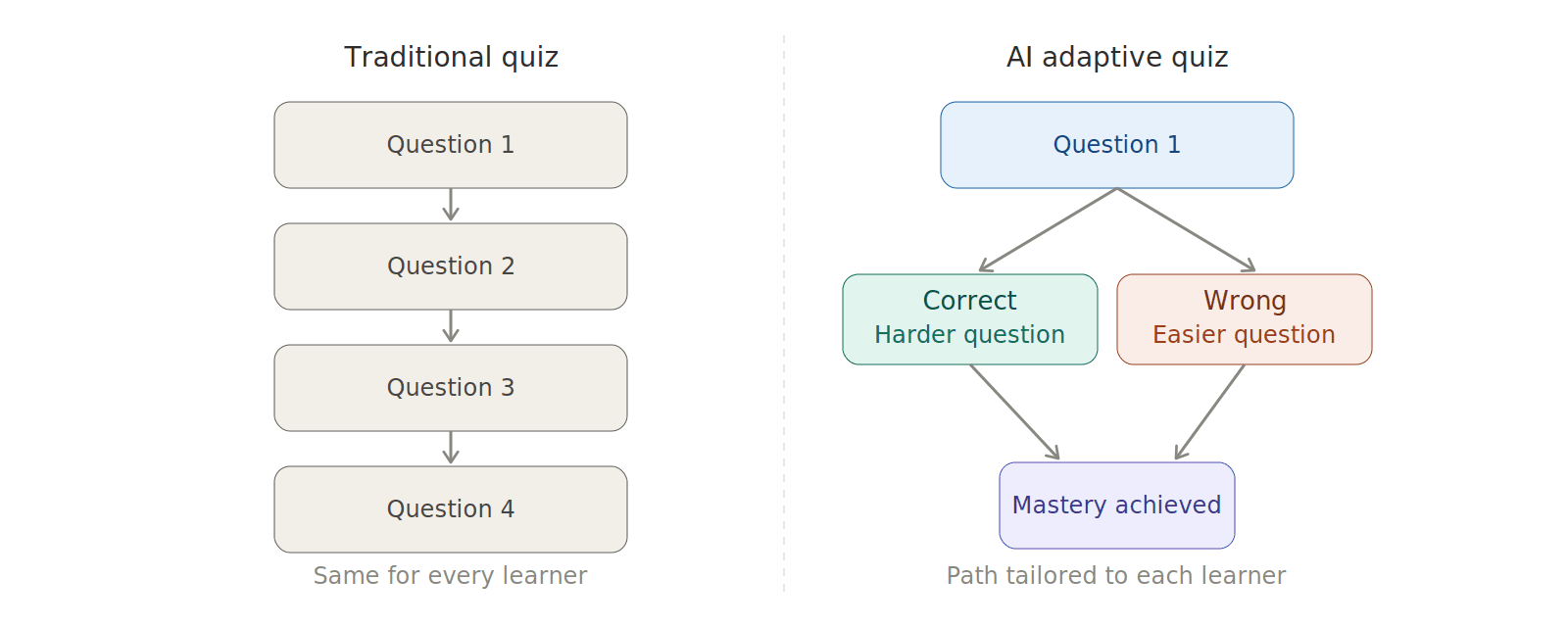
Perhaps the single greatest advantage of AI quizzes is adaptive testing. In a traditional quiz, every student encounters the same questions in the same order, regardless of whether they are struggling with foundational concepts or have already mastered advanced material. This one-size-fits-all approach means that high-performing students may be bored, while underperforming students may feel overwhelmed - neither of which promotes optimal learning.
Ai-powered assessments solve this by applying algorithms, often based on Item Response Theory (IRT) or Bayesian knowledge tracing, that estimate a learner's ability level after each response and select the next question accordingly. Therefore, it can generate a quality personalized assessments at scale. A comprehensive overview of how adaptive learning platforms work in 2026 shows that modern systems combine continuous micro-assessments, real-time feedback loops, and AI-driven content recommendations to create truly individualized learning journeys.
This personalization has measurable effects. A scoping review published in PMC found that 59% of studies observed increased academic performance after implementing personalized adaptive learning, with particularly strong results in STEM fields. Corporate training programs report that adaptive quizzes can reduce time-to-competency by 20–40% because learners spend less time on material they already know and more time on areas where they need reinforcement.
Traditional Quizzes
Traditional quizzes, by contrast, treat every student identically. While this uniformity is a disadvantage for learning purposes, it is precisely the quality that makes traditional formats indispensable for standardized testing, where fairness requires that every examinee faces the same challenge under the same conditions. For high-stakes certification and board exams, the absence of adaptive variation is a feature, not a flaw.
3) Grading, Feedback, and Analytics
AI Quizzes
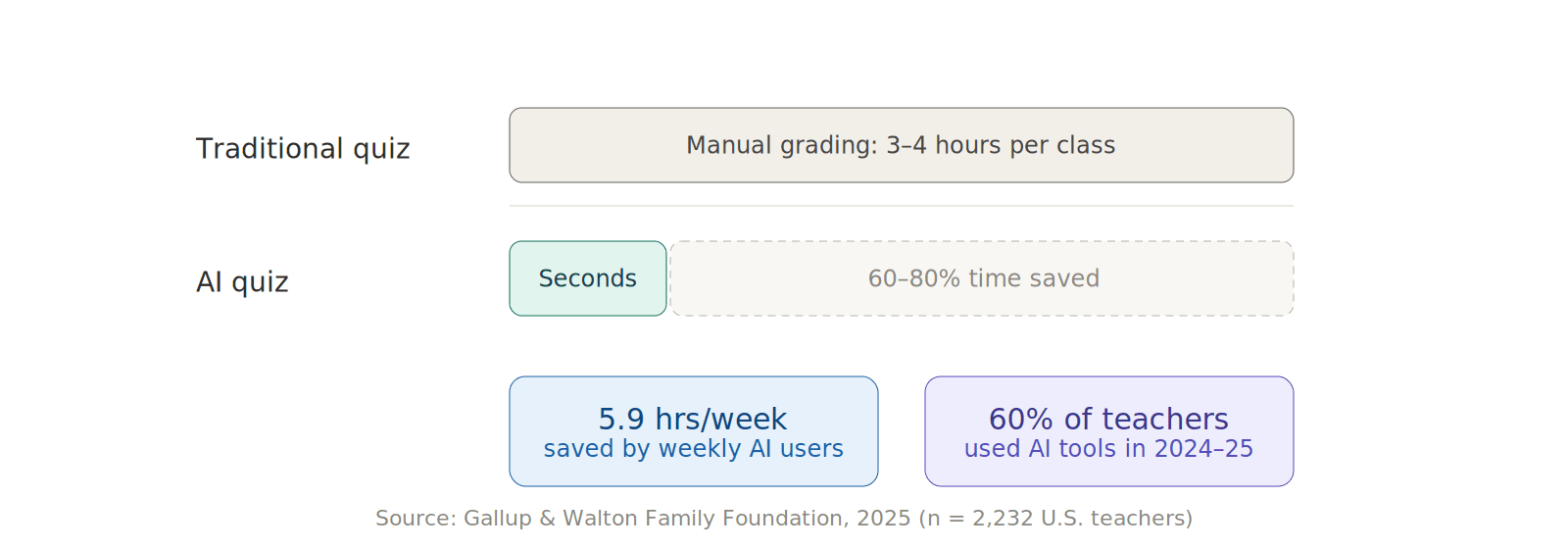
Grading efficiency is an area where AI quizzes hold an overwhelming advantage. A traditional quiz with 30 students and five open-ended questions can easily require three to four hours of manual grading. Scale that to 300 students, common in a university lecture hall or a company-wide compliance training, and the grading burden becomes enormous. According to a 2026 analysis of AI in educational assessment, institutions implementing AI-based grading report 60–80% reductions in grading time and 30–50% improvements in assessment consistency.
AI platforms grade all question types instantly, including open-ended responses. Using NLP, these systems evaluate short-answer and essay responses against rubric criteria, checking for key concepts, argument structure, and factual accuracy. A report from The Schoolhouse on AI grading tools estimates that over 60% of educators are expected to adopt AI for grading and assessments by 2026.
AI quiz platforms also generate analytics that are impossible to replicate manually. Instructors can view class-wide knowledge gap maps, identify topics that produced the most confusion, and track individual student progress over weeks or months. According to a 2025 Gallup and Walton Family Foundation survey of 2,232 U.S. teachers, 60% used AI tools during the 2024–25 school year, and those who used them at least weekly saved an average of 5.9 hours per week—much of it previously spent on grading and assessment prep.
Traditional Quizzes
Traditional quiz feedback is typically limited to correct/incorrect indicators, delivered after a delay. Students who receive results days later rarely have the context to act on them effectively. Analytics are limited to score distributions and averages unless the instructor invests additional time in manual spreadsheet analysis. For instructors managing large classes, this gap in feedback quality and analytical depth can meaningfully slow the pace of instructional adjustment.
4) Cost and Accessibility
AI Quizzes
AI quiz platforms operate on subscription models. Pricing varies widely—from as low as $3 per user per month for basic adaptive quiz tools to $15 or more per user per month for enterprise-grade platforms with advanced analytics, LMS integration, and AI proctoring. For an organization with 500 learners, that translates to $1,500 to $7,500 per month, a significant line item that must be justified by measurable improvements in learning outcomes or operational efficiency. It helps to view these costs in context: the broader edtech market is expected to reach roughly $214.58 billion in 2026, reflecting how heavily institutions are investing in digital learning infrastructure overall.
AI quizzes also require a reliable internet connection and a compatible device. In many parts of the world and in underserved communities within developed countries these requirements are not guaranteed, creating access barriers that traditional formats do not face.
Traditional Quizzes
The cost advantage of traditional quizzes is hard to beat. Any instructor with a word processor or access to a free form builder like Google Forms can create, distribute, and collect quiz results at zero cost. Paper-based quizzes can be administered anywhere, including in locations without electricity or internet access, making them the more inclusive option in low-resource environments. There are no subscriptions, no in-app purchases, and no risk of a pricing change disrupting your assessment routine.
Best Use Cases
When AI Quizzes Are the Better Choice
AI quizzes are ideal for formative assessment, the ongoing, low-stakes testing that helps learners identify gaps in their knowledge and guides instructors on where to focus their teaching. They are also well-suited for corporate training at scale, where hundreds or thousands of employees need to be assessed on compliance topics, product knowledge, or onboarding material. The automation of question generation, grading, and reporting makes AI platforms dramatically more efficient than traditional methods in these scenarios.
Self-paced learning environments, such as online courses, certification prep programs, and professional development platforms, also benefit enormously from the adaptive capabilities of AI quizzes. If you need a full-length formal assessment rather than a knowledge check, our AI Test Generator can produce structured, multi-section tests with answer keys and difficulty calibration in minutes.
When Traditional Quizzes Are the Better Choice
Traditional quizzes remain the gold standard for high-stakes summative assessment. Standardized tests, board exams, professional certifications, and final examinations all require the kind of rigorous item development, field testing, and psychometric validation that AI auto-generation cannot yet reliably deliver. These settings also demand strict proctoring protocols, fixed test conditions, and defensible scoring procedures, all of which are more straightforward to implement and audit in a traditional format.
Small classroom settings where instructors know their students individually also favor traditional quizzes. In these environments, the instructor can design questions that address specific discussions, assignments, or classroom experiences, a level of contextual tailoring that AI cannot match. For a balanced view of where AI helps and where it falls short in education broadly, our article on the pros and cons of AI in education covers the full picture.
Security, Integrity, and Cheating Prevention
AI Quizzes
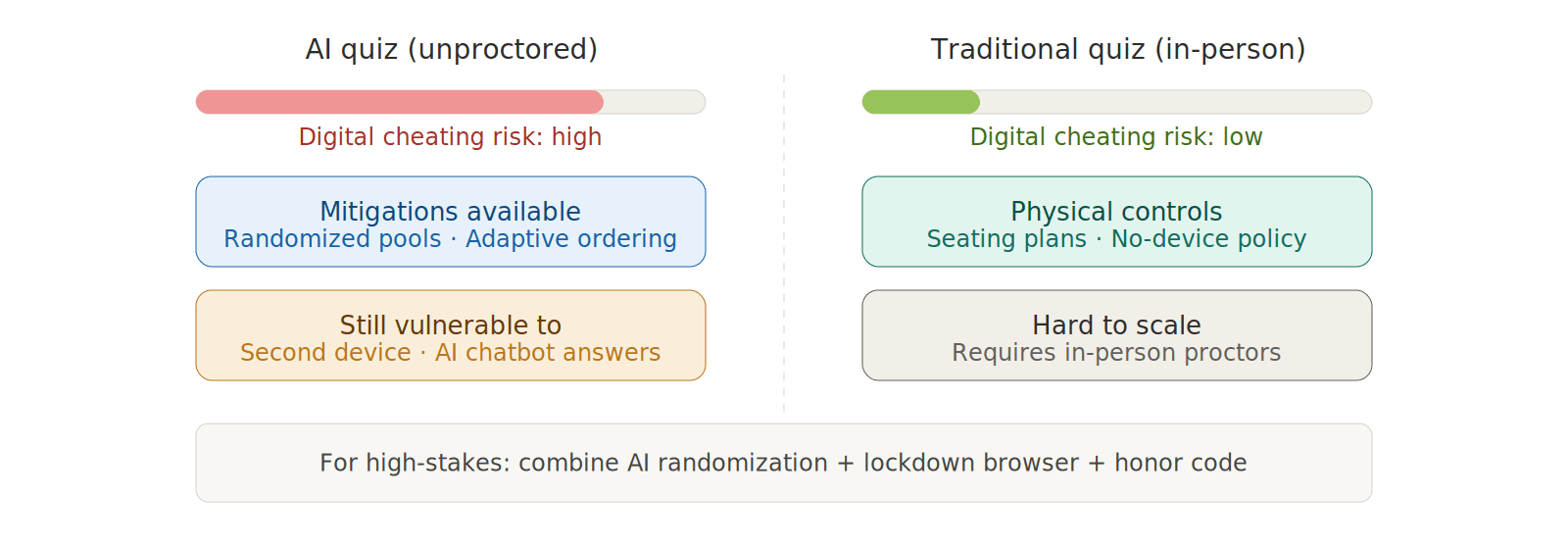
AI quiz platforms approach integrity from a technology-first perspective. Adaptive item selection means that no two students receive the same set of questions in the same order, making answer-sharing far less effective. Many platforms also integrate with AI-powered proctoring services that use webcam monitoring, screen recording, and behavioral analysis to detect suspicious activity during an exam.
However, AI quizzes are inherently more vulnerable to certain digital-age threats. Students can use separate devices, browser extensions, or their own AI tools to look up answers during an unproctored online quiz. AI proctoring tools have also faced criticism over privacy concerns and algorithmic bias in facial recognition, factors worth evaluating carefully before implementation.
Traditional Quizzes
Traditional quizzes rely on physical controls - assigned seating, multiple test versions, in-person proctors, and no-device policies that are well-established but difficult to scale in online or hybrid learning environments. In a controlled room, however, pen-and-paper exams eliminate virtually all digital cheating vectors entirely, making them the more defensible choice for high-integrity assessment contexts.
The Bottom Line
AI quizzes and traditional quizzes are not competitors - they are complements. AI-powered platforms deliver unmatched speed, personalization, and analytics that make them the superior choice for formative assessment, self-paced learning, and training programs at scale. Traditional quizzes offer the standardization, human oversight, and offline accessibility that remain essential for high-stakes exams and low-resource settings.
For most educators and organizations, the optimal strategy is a hybrid model: use AI quizzes for daily practice, homework, and knowledge checks where instant feedback and adaptive difficulty accelerate learning; reserve traditional quizzes for midterms, finals, certifications, and any assessment where regulatory compliance or psychometric rigor is required. The goal is not to find the "best" quiz format in the abstract, but to build an assessment strategy that works reliably for your learners and your context.